
How Does Business Process Automation Work in Practice?
Business Process Automation (BPA) means using technology to execute repetitive, predictable tasks without human intervention. Instead of your team copying data from one system to another, manually sending follow-up emails, or generating reports at the end of every month, these actions are executed automatically by software.
This isn’t about replacing people. It’s about freeing them from work that doesn’t require critical thinking — so they can focus on what actually drives value: strategy, client relationships, and complex decisions.
According to a McKinsey Global Institute report, approximately 60% of all occupations have at least 30% of activities that could be automated. The question isn’t “if” — it’s “when” and “how fast.”
How Does Business Process Automation Work in Practice?
At a fundamental level, automation follows a simple logic: trigger → action → result.
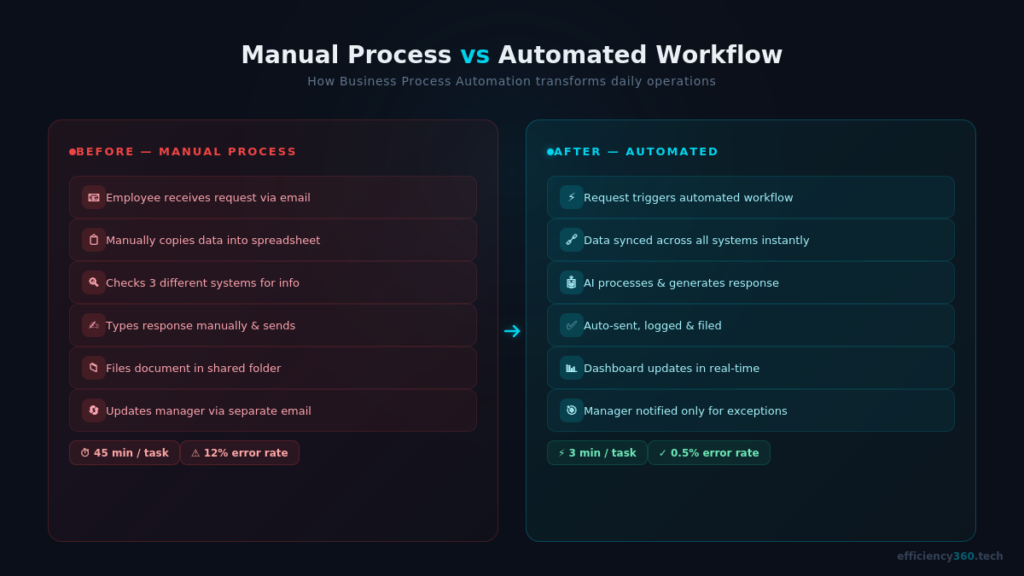
A concrete example: a client fills out a form on your website. Automation captures the data, enters it into your CRM, sends a confirmation email to the client, assigns the lead to a sales rep based on geographic region, and creates a task in your internal project management system. The entire process takes 3 seconds. Done manually, it would have taken 15 minutes and involved 3 people.
Modern automation platforms — such as Make (formerly Integromat), n8n, Zapier, or Microsoft Power Automate — work by connecting the applications you already use. You don’t need to abandon your existing tools. Automation links them together.
What Types of Processes Can Be Automated?
Practically any repetitive, rule-based process with defined steps is a candidate for automation. The most common areas include:
Marketing and Sales — lead nurturing, automated email campaigns, lead scoring, real-time reporting, personalised quote generation.
Operations and Administration — invoicing, document management, internal approvals, order management, automated financial reporting.
Human Resources — new employee onboarding (account creation, training assignment, document delivery), offboarding, leave request management.
IT and Support — automated ticketing, intelligent escalations, scheduled backups, system monitoring.
According to the Deloitte Global RPA Survey, companies that implement automation report an average 20% reduction in operational costs within the first year.
BPA vs. RPA vs. AI — What’s the Difference?
These three terms are often confused, but they serve different purposes:
BPA (Business Process Automation) is the umbrella term. It refers to end-to-end process automation, from workflow design to execution. It includes system integration, business logic, and the orchestration of multiple applications.
RPA (Robotic Process Automation) is more specific. It uses “software robots” that mimic human actions on screen — clicks, data copying, form filling. It’s ideal for legacy systems that lack modern APIs. Gartner estimates the RPA market exceeded $3 billion in 2025.
AI (Artificial Intelligence) adds a layer of intelligence on top of automation. Instead of just following fixed rules, AI systems can interpret unstructured documents, generate text, classify emails by sentiment, or predict customer behaviour. Combined with BPA, AI transforms automation from “mechanical execution” into “intelligent decision-making.”
The most effective implementations combine all three: BPA for orchestration, RPA for legacy systems, and AI for tasks that require interpretation.
Why Automation Matters in 2026 — Especially for Companies in Romania and the EU
Romania is at an inflection point. Labour costs are rising, competition is intensifying, and the pressure to deliver faster won’t ease. According to Eurostat data, Romania has had one of the highest increases in labour costs across the EU over the past 5 years.
For mid-size companies (50–500 employees), automation is no longer a luxury — it’s a competitive necessity. Companies that automate now will have a structural advantage over those that delay: faster processes, fewer errors, lower cost per transaction, and the ability to scale without proportionally increasing headcount.
Moreover, compliance with EU regulations (GDPR, eIDAS, e-invoicing) becomes far easier to manage when processes are standardised and automatically documented — every action has an audit trail.
Where Do You Start?
You don’t have to automate everything at once. The most successful implementations start with a single process that meets three criteria: it’s repetitive, it consumes significant time, and it has clear, predictable steps.
Our recommendation: start with an automation audit. Identify the 3–5 processes that consume the most time on your team, evaluate each one’s automation potential, and prioritise based on impact and complexity.
The result? A clear roadmap with quick wins that generate ROI within weeks and strategic projects that fundamentally transform the way you operate.
Your Next Step
If you want to find out exactly how much time and money you could save through automation, book a free 30-minute audit with the efficiency360 team. We analyse your current processes, identify opportunities, and give you a personalised roadmap — no strings attached.
