
No company deliberately decides to waste money. But in every organisation, there are processes that — accumulated — consume thousands of hours and tens of thousands of euros per year, without anyone noticing. Why? Because “that’s how we’ve always done it.”
According to an IDC study, employees in an average company spend approximately 20–30% of their working time searching for information or handling repetitive tasks. Translated into money, for a company with 100 employees, that’s the equivalent of 20–30 full-time salaries lost to work that could be automated.
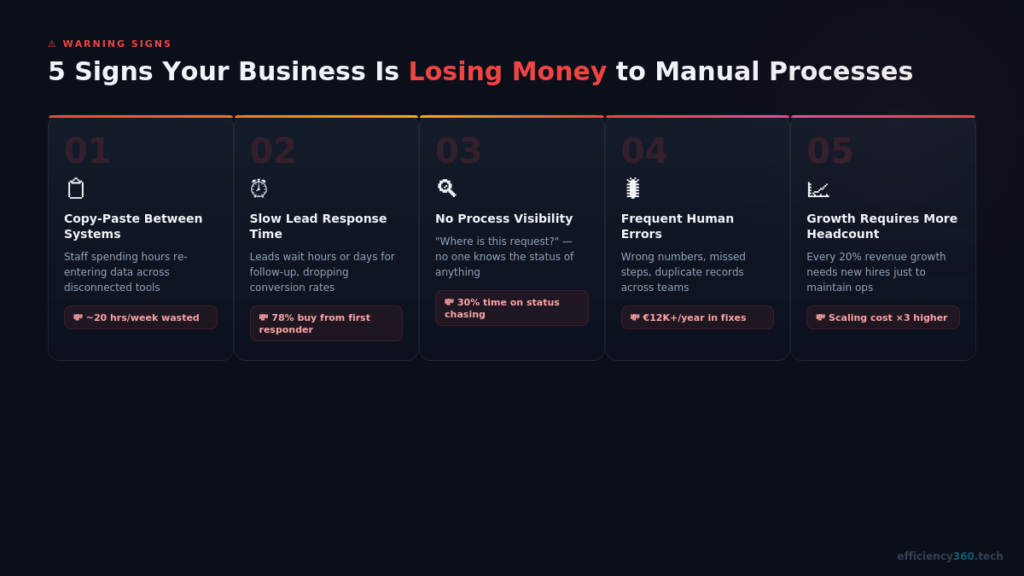
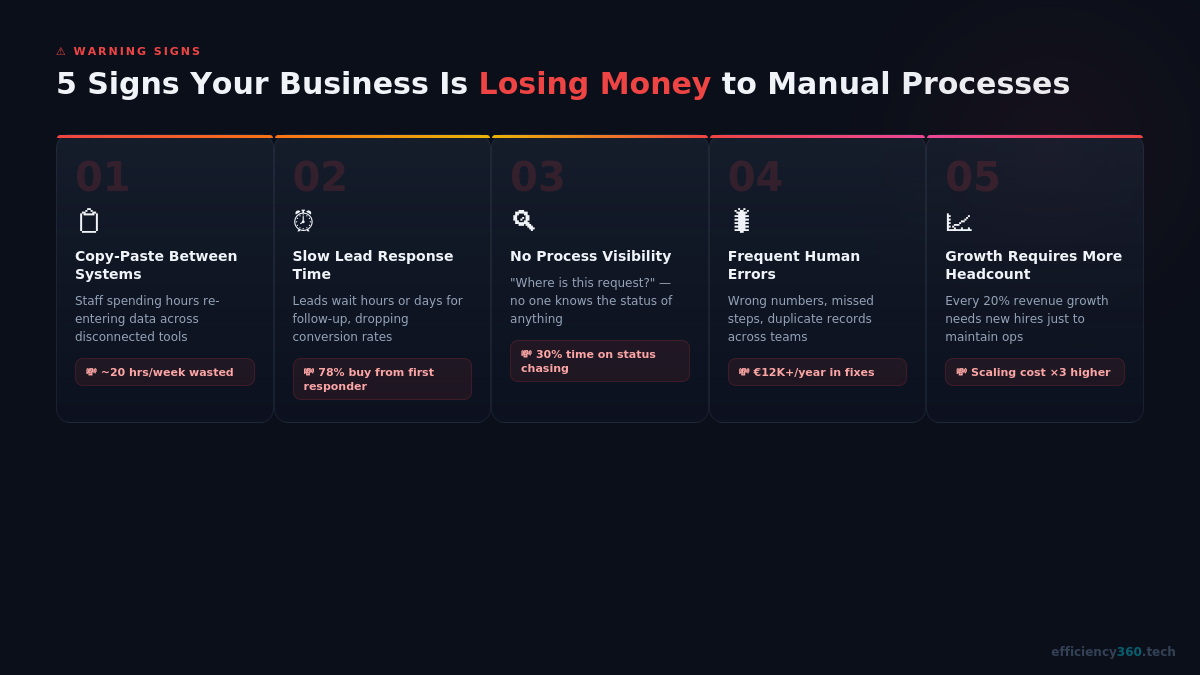
Here are the 5 signs we see most frequently in the companies we work with — and they all point to real losses from manual processes.
1. Your Team Is Copying Data Between Systems
If someone on your team spends time every day copying data from emails into Excel, from Excel into the CRM, from the CRM into the invoicing tool — you have a solvable problem. Every manual data transfer is an opportunity for error. According to Gartner, data errors cost organisations an average of $12.9 million per year.
It’s not just the risk of mistakes. It’s the time. An employee spending 30 minutes a day copying data consumes 125 hours per year — the equivalent of 3 full weeks of work. Multiply that across 10 employees, and you’re looking at 7 person-months lost.
The solution isn’t hiring more people to copy data faster. It’s connecting your systems through automation so data flows on its own, in real time, without human intervention.
2. Leads Are Contacted After Hours or Days — Not Minutes
A Harvard Business Review study showed that companies who contact a lead within the first 5 minutes are 100 times more likely to get a response than those who wait 30 minutes. After an hour, the odds drop dramatically.
If your process looks like this — lead fills out form → lands in inbox → someone sees it the next day → manually adds to CRM → sends a generic email — you’re losing money with every passing minute. A competitor with an automated system sends a personalised email within 30 seconds, automatically assigns the lead to the right sales rep, and creates scheduled follow-ups.
The difference isn’t just speed. It’s conversion. Every hour of delay in response time reduces lead qualification rates by up to 10x.
3. Reports Are Built Manually in Excel Every Monday Morning
If someone on your team spends the first hours of every week compiling data from multiple sources into a spreadsheet for the “Monday morning report” — that’s a clear signal of inefficiency.
Manual reporting has three fundamental problems: it consumes time, it’s prone to errors, and it’s always delayed. By the time the report is ready, the data is already hours or days old. Decisions based on stale data are, by definition, suboptimal decisions.
With an automated dashboard (connected to your CRM, marketing platform, and invoicing system), data is updated in real time. No one spends 3 hours compiling — instead, the management team looks at a live dashboard and makes decisions on the spot.
According to a Forrester report, companies that adopt automated reporting save an average of 8–12 hours per week at the management team level.
4. Onboarding a New Employee Takes Weeks
When a new employee joins the team, how many manual emails get sent? How many accounts are created by hand? How many documents get printed, signed, and scanned?
In a company without automation, onboarding can take 2–4 weeks before the new hire has access to all systems, completed all forms, and received all training materials. SHRM (Society for Human Resource Management) estimates the average cost of onboarding a new employee is approximately $4,700 — and a significant portion of that cost comes from time wasted on administrative tasks.
With automation, the moment a contract is signed triggers everything automatically: account creation, sending documents to fill out (with e-signatures), assigning training modules, notifying the manager and IT team. The new employee has everything ready on Day 1.
5. The Team Works Overtime, but Output Doesn’t Scale Proportionally
This is the most subtle and most dangerous sign. People are working hard — but productivity per employee stagnates or declines. Why? Because an ever-growing portion of their time is consumed by administrative work, not productive work.
An Asana study from 2023 (Anatomy of Work Index) revealed that employees spend an average of 58% of their time on “work about work” — coordination tasks, searching for information, updating statuses, filling out forms — not the specialised work they were hired to do.
When you scale without automation, you add people doing the same manual work. Costs rise linearly, but efficiency doesn’t. Automation breaks this pattern: it lets you scale volume without proportionally scaling headcount.
How Much Is This Actually Costing You?
Let’s do a simple calculation. If 10 employees each lose 2 hours per day on automatable tasks, at an average hourly labour cost of €15 (including taxes and benefits):
10 employees × 2 hours × 250 working days × €15 = €75,000 per year lost to work that software could handle.
Most automation projects pay for themselves within 3–6 months. The maths is straightforward.
What Can You Do Right Now?
The first step isn’t buying a tool or hiring a consultant. The first step is to measure. Identify the 3 processes consuming the most time on your team and calculate the real cost: how many hours, how many people, what error rate.
If you’d like to do this exercise with someone who’s seen dozens of companies in the same situation, book a free automation audit with the efficiency360 team. In 30 minutes, we identify where you’re losing the most time and give you a concrete roadmap.
