From 6 Hours to 90 Seconds: How We Automated Lead Response and Tripled Our Call Booking Rate
The Numbers That Matter
What Was Broken
Before building our own automation system, our lead response process looked like every other small agency: someone fills out the contact form, WordPress sends a notification email, and whenever we happened to check our inbox — usually hours later — we'd manually copy the lead's details into a spreadsheet, write a personalized response, and send it.
The average response time was 6 hours. On weekends or busy days, it could stretch to 18–24 hours. By that point, leads had already reached out to competitors, lost the urgency that made them fill out the form in the first place, or simply moved on.
We were also losing visibility. Without proper CRM tracking from the very first second, we had no idea which leads came from which source, how many we were actually converting to calls, or where prospects were dropping off. Every month felt like guessing.
The worst part? We were selling automation to clients while our own lead process was entirely manual. That had to change.
How We Built It
Tool-Agnostic by Design
The automation logic — routing, parallel execution, error handling, status callbacks, scheduled follow-ups — stays the same regardless of which tools you use. Swap Brevo for HubSpot, Salesforce, or Pipedrive. Replace Slack with Microsoft Teams, Discord, or WhatsApp. We plug into whatever your team already runs.
What We Built
We designed and deployed the exact system we now recommend to clients — a complete lead response automation built with Make (Integromat), Brevo, Slack, and our WordPress site. The entire architecture uses Brevo as a unified platform for both CRM (contact management) and transactional email, keeping the stack lean and the data in one place.
The architecture works in five steps, all triggered the instant someone submits our demo form:
Step 1 — Form Capture. The WordPress form collects the lead's name, email, phone, company, and automation interest area. It submits via AJAX — no page reload — and fires a webhook payload to Make in under one second. A GDPR consent checkbox ensures full EU compliance. Spam protection uses a honeypot field plus IP-based rate limiting (3 submissions per hour). No CAPTCHA, no friction.
Step 2 — Orchestration. Inside Make, a Custom Webhook module (Module 1) receives the JSON payload containing the lead's details, a unique submission UUID, and a callback URL. A Router module (Module 2) immediately splits the data into three parallel branches that execute simultaneously. This parallel processing is what makes the entire response happen in seconds instead of minutes.
Branch 1 — CRM (Modules 3–5). An HTTP module calls the Brevo Contacts API to create or update the lead's record with their name, company, interest area, lead source ("demo-lead-response"), and a unique tracking UUID. The updateEnabled: true flag ensures returning leads get their records updated rather than duplicated. A Resume error handler (Module 4) catches duplicate-contact errors gracefully, so the scenario never stops running. Once the CRM record is confirmed, a callback HTTP module (Module 5) sends a POST request back to WordPress reporting step: crm_done, which updates the real-time progress tracker the visitor is watching on screen.
Branch 2 — Email + Nurture Sequence (Modules 6–9). An HTTP module calls the Brevo Transactional Email API to send a fully branded, personalized welcome email within 5–10 seconds of form submission. The email uses the lead's first name, references their specific interest area, and includes a clear "Book a Discovery Call" CTA. Immediately after sending, two Data Store modules (Modules 7 and 8) queue the follow-up emails: Email 2 is scheduled for 24 hours later (a relevant resource based on their interest selection) and Email 3 for 48 hours (a case study with a final booking CTA). Each record stores the lead's UUID, email, name, company, interest, email number, scheduled send time, and a "pending" status. A separate Make scenario polls the Data Store on a schedule, picks up pending records whose send_at time has passed, sends the email, and marks them as "sent." A callback module (Module 9) reports step: email_sent,sequence_scheduled to WordPress.
Branch 3 — Team Notification (Modules 10–11). An HTTP module sends a formatted JSON payload to a Slack incoming webhook, posting a rich notification to our #new-leads channel with the lead's name, email, company, interest area, submission timestamp, and UUID. The team sees the alert within seconds — on desktop and mobile. A final callback module (Module 11) reports step: slack_sent to WordPress, completing the progress tracker.
On the WordPress side, the progress tracker polls every 2 seconds via AJAX, and each step lights up with a checkmark animation as callbacks arrive. The visitor watches the automation execute in real time — CRM record created, email sent, sequence scheduled, team notified — all before they've closed the browser tab. If Make is temporarily unavailable, the system degrades gracefully with a "We'll email you shortly" fallback message.
The entire system was built and tested in two days and went live the same week. Total platform cost: €0/month using free tiers across the board.
Tech Stack
What Changed
The results showed up in the first week and kept compounding over the first 90 days.
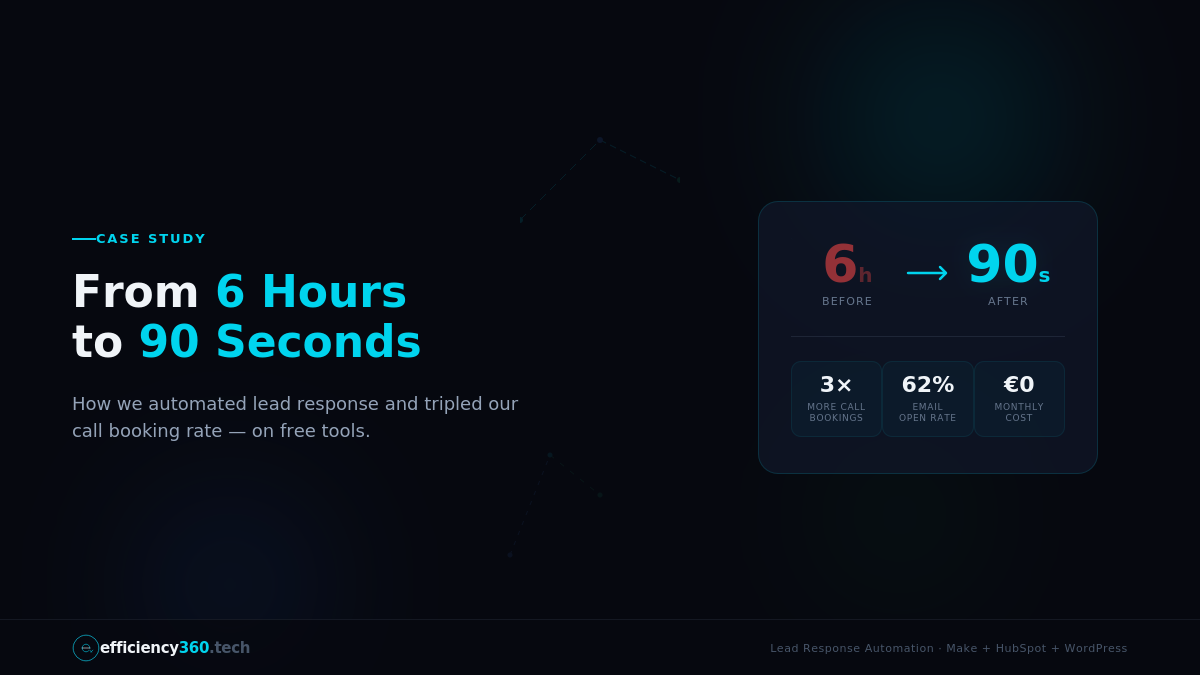
Lead response time dropped from an average of 6 hours to under 90 seconds. Every lead now receives a personalized email, has a CRM record created, and triggers a sales notification — all before they've even closed the browser tab. On weekends and evenings, the response time is identical: the system doesn't sleep.
Our welcome email open rate hit 62% — more than triple the B2B industry average of ~20%. The immediate delivery timing is the key factor: leads open the email because they just submitted the form and their attention is still engaged.
Click-through rate on the "Book a Call" CTA in the welcome email reached 11.4%, compared to the 2–3% we saw with manual follow-ups sent hours later.
Call booking rate from form submissions increased from 8% to 24% — a 3x improvement from the same traffic and the same website. The only variable that changed was speed.
We recovered approximately 4 hours per week in manual work that previously went to copying form data into CRM, writing individual response emails, forwarding lead details to the team via WhatsApp, and manually tracking which leads had been contacted. At scale (50+ leads/month), this compounds to 15–20 hours recovered monthly.
The system also produced our first case study — this one — automatically. Every metric was tracked from day one because the automation logs everything by default.
Perhaps the most powerful outcome: prospects who experience our instant response firsthand immediately understand the value of automation. Several clients have told us that the speed of our initial reply was what convinced them to book a call. We're not just telling people automation works — we're proving it in real time, every time someone fills out our form.
Before vs. After
We built this system for ourselves first — because you should never sell something you haven't proven with your own numbers. Every lead who contacts efficiency360.tech experiences our automation in real time, before we ever get on a call. That's the most convincing sales pitch we could make.
efficiency360.tech Business Automation & Professional Services
Ready for Results Like These?
Book a free automation audit — we'll identify the 3 biggest efficiency wins hiding in your operations. We work with whatever CRM, email, and messaging tools your team already uses.